
How Riot Games Poured Millions into War-Torn Ukraine Relief
Riot Games charity donation for Ukraine raised $5.4 million from Bee skins, supporting medical aid and reflecting the studio's philanthropic mission.
I remember the exact moment I first saw the notification pop up on my phone. It was a chilly evening in March 2022, and I had settled in for a typical night of grinding the bottom lane. The message from the official League of Legends account wasn't about a balance patch or a flashy new event, though. It was a stark, sobering statement that the proceeds from the newest Bee skins and the current Battle Pass would flow not into the company’s vaults, but directly toward humanitarian groups scrambling to save lives in Ukraine. I stopped playing and started reading. The conflict between Russia and Ukraine had felt overwhelmingly immense and distant, yet here was a direct line from my favorite digital pastime to the very real suffering of a nation under siege.
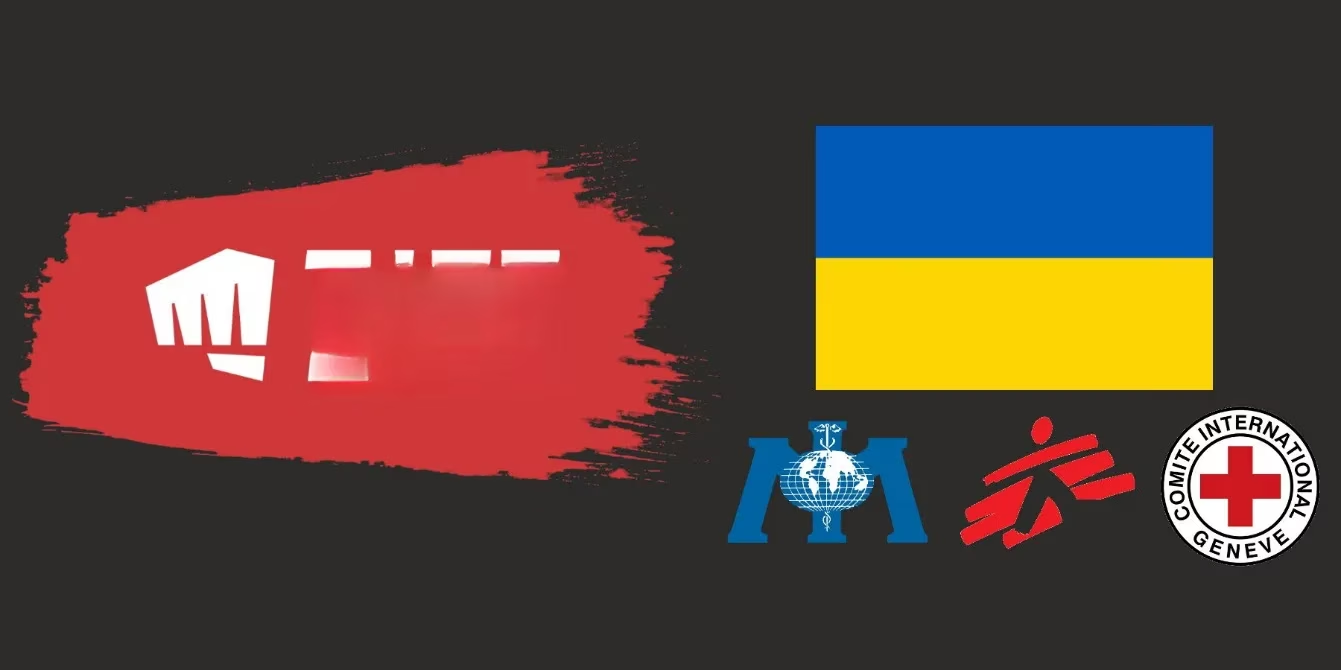
The numbers, once the campaign concluded, were staggering. From March 5th to March 12th, the community’s appetite for whimsical bee-themed cosmetics translated into a $5.4 million lifeline. That single week’s worth of microtransactions was earmarked for distribution among three key organizations: the International Medical Corps, Doctors Without Borders, and the International Committee of the Red Cross. As a player who often grumbles about skin prices, I felt a weird surge of pride. My fellow summoners and I had, in a very small way, turned our hobby into a vehicle for delivering frontline medical aid and logistical support. It reframed the entire concept of a battle pass for me—no longer just a treadmill of rewards, but a communal act of witness and generosity.
This wasn’t Riot’s first rodeo when it came to high-stakes altruism, though. Far from it. Looking back, I realized how deeply embedded this ethos is in their annual rhythm. For years, the studio has leveraged the massive pull of champion aesthetics for good. The clearest proof was the Elderwood Ornn charity skin released at the tail end of 2020. That project, which ran into January 2021, funneled over $7 million straight into the Riot Games Social Impact Fund. I remember buying that skin myself, drawn less by the ram god’s new threads and more by the promise that the money would weave its way into a global network of humanitarian organizations. The fund acts as Riot’s own philanthropic engine, directly investing in change-makers around the world, a fact that makes the eventual destination of those millions feel less like a corporate write-off and more like a genuine strategic mission.
Looking at the broader landscape of that period, Riot was hardly a lone actor in this digital exodus of goodwill. The entire gaming industry seemed to react with an instinctive, collective flinch against the violence. My inbox and social feeds were flooded with announcements. Epic Games took a similarly direct financial route, shoveling two weeks' worth of Fortnite proceeds—from March 20th through April 3rd—straight into relief funds. The sheer scale of V-Buck purchases redirected towards medical corps and child services was a testament to the gravitational pull a battle royale can exert on real-world logistics. Meanwhile, other titans adopted a more punitive, business-oriented strategy. Electronic Arts and Sony didn't just write checks; they hit the pause button on their entire commercial presence in Russia. It was a different form of protest, one that removed products from virtual shelves as a statement against the invasion.
Just before those industry-wide moves picked up steam, Humble Bundle’s “Stand for Ukraine” bundle had already blazed the trail with an astonishing outcome. It managed to transcend the usual indie game collections by pooling offerings from dozens of developers, ultimately raising a monumental sum that eclipsed $20 million. That effort, coupled with major streamers like Asmongold burning their own on-stream hours to spike donation counts, proved the pipeline from pocket change to paramedic kits was dangerously efficient. Watching these disparate corners of the hobby converge on a single goal created a strange dissonance: the world of boss fights and neon cosmetics had morphed into one of the most responsive emergency fundraising networks on the planet.
The year these donations happened, 2021, felt like a pivot point for Riot in more ways than one, a fact I’ve spent countless hours debating on forums. The studio’s growth was not just financial; it was architectural and narrative. The release of Arcane , the long-awaited animated series, didn’t just satisfy lore nerds like me—it demolished the barrier between video game adaptation and prestige television. The critically acclaimed show brought a flood of newcomers into the fold, people who had never last-hit a minion but found themselves weeping over the tragedy of Zaun. Concurrently, the Riot Forge program finally bore tangible fruit. I sunk dozens of hours into the turn-based bliss of Ruined King and the frantic, explosive chaos of Hextech Mayhem , realizing that the universe could no longer be contained within a single MOBA client. There was a palpable sense that Riot was becoming less of a games company and more of a sprawling entertainment entity.
With such a robust foundation laid, the immediate future after the 2022 charity wave looked blindingly bright from my perspective. As the money was being counted and dispatched to the ICRC and Doctors Without Borders, whispers were already circulating about Riot’s internal roadmap. The success of the Riot Forge experiments all but guaranteed a second wave of these third-party titles, promising deeper dives into regions of Runeterra we’d only glimpsed in splash art. More pressingly, the confirmation of Arcane Season 2 being in the works dangled the tantalizing prospect of returning to Piltover’s gilded towers and the Lanes’ grime.
Thinking back now from where I sit in 2026, the March 2022 charity drive was a defining stamp on Riot’s character, but it was also a prelude. The $5.4 million wasn't just a donation; it was a broadcast, a clear signal that the company's massive, often criticized, in-game economy could swivel on a dime to serve a humanitarian purpose. That chunk of change, mingling with the billions generated by Fortnite and the hard work of bundled indies, formed a digital armada of aid. It set a precedent that I still feel today whenever a new skin line drops. Every time I see a charity announcement linked to a cosmetic, I'm back in that moment, realizing that the pixels on my screen occasionally have the power to build something tangible, like a field hospital or a supply truck, in the real world. And that’s a legacy far stickier than any Victory screen.
-
💰 $5.4 million raised in just one week
-
❤️🩹 Funds distributed to: International Medical Corps, Doctors Without Borders, and the ICRC
-
🐝 Method: Proceeds from specific in-game Bee skins and the Battle Pass
-
📈 Previous effort: Elderwood Ornn skin raised $7 million in 2020/21
-
🎬 Cultural context: Huge corporate growth fueled by Arcane and new Riot Forge titles