
The Eternal Brawl Stars Debate: Could 100 Average Players Overwhelm an Esports Pro in 2026?
A Brawl Stars showdown pits an esports pro against 100 average players, sparking a chaotic debate on skill versus swarm tactics.
The Brawl Stars community, ever vibrant and endlessly argumentative in the year 2026, had found a new obsession that lit up forums, Discord servers, and streaming chats like a supercharged Bo mine. The question was deceptively simple: in a single massive Showdown match, who would emerge victorious—an esports champion, alone and armed with nothing but godlike reflexes and meta mastery, or a chaotic swarm of one hundred everyday players? The debate was not just a matter of stats and strategies; it was a glorious, meme-fueled philosophical war about the very soul of the game, where precision brawling met the beautiful, bewildering tornado of casual play.
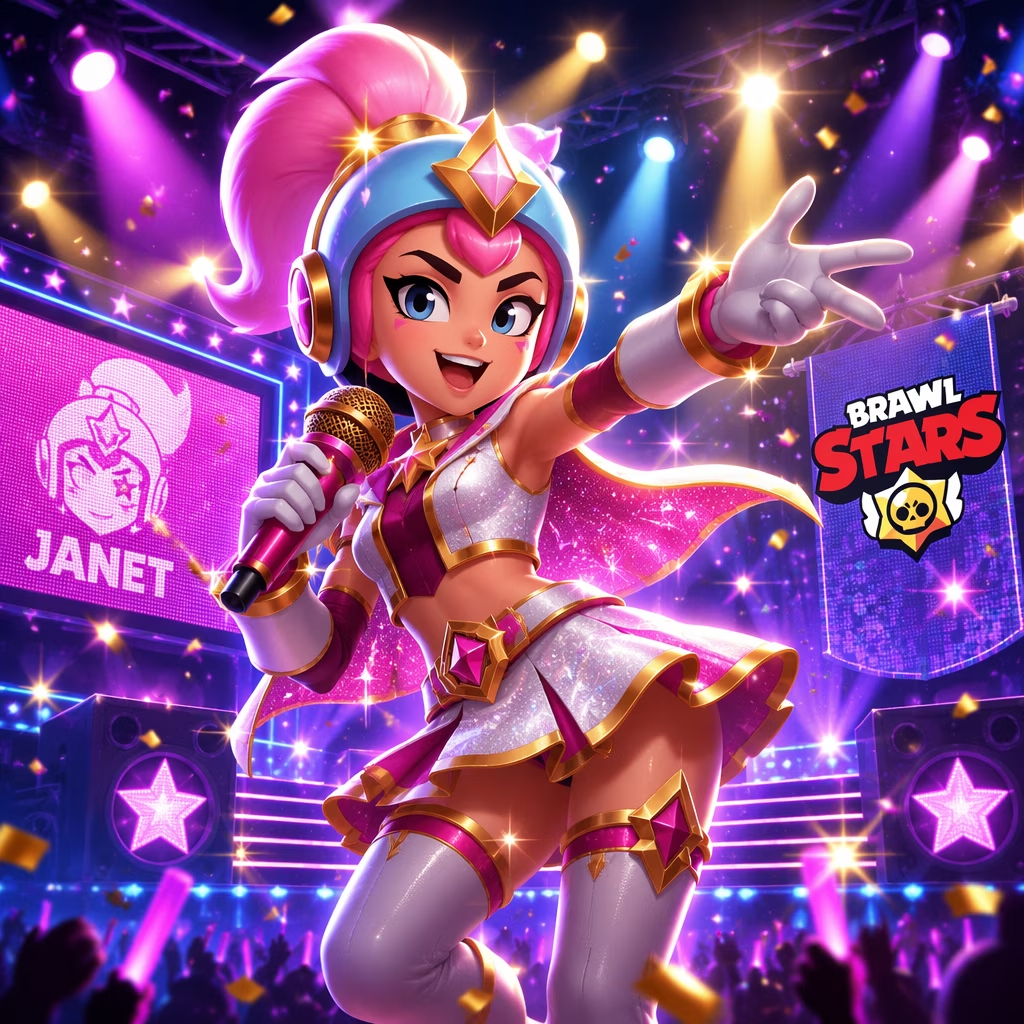
From the outset, the discussion splintered into two primal camps. Those who backed the pro painted a picture of surgical domination—a lone virtuoso dancing through the mayhem like a concert pianist trying to play Chopin while the audience pelts him with beach balls, yet somehow hitting every note. They argued that a tier-one competitor, equipped with the latest 2026 balance patches and a brawler like Mico or the reworked Kong Surge, possessed movement so fluid and game sense so deep that a hundred average Joes would be nothing more than target practice. The pro would weave through attacks, picking off opponents one by one, turning the map into a silent, deadly clinic.
Yet, the opposing view held a far more entertaining truth. To them, the pro wasn't a pianist; he was a lone wolf stumbling into a hornet's nest of pure, unadulterated chaos. The sheer mathematics of 100 players on a single screen transformed the battlefield into something closer to a Jackson Pollock painting—splatters of energy drinks and panic supers flying in every direction. The concept of "dodging" became a cruel joke when you had to avoid not just enemy fire but also the friendly fire of a hundred players who, as one Reddit wit put it, were all holding Dynamike and suffering from main-character syndrome. The match would not be a competitive clash; it would be a spectacular self-destruct sequence.
The friendly fire variable was the great equalizer, a game mechanic that turned the entire thought experiment into a comedy of errors. Imagine the scene: a hundred brawlers spawning into a custom map, a chorus of "Brawl On!" ringing in their ears, and within seconds the first super goes off-target. A Dynamike stuns his own three teammates. An Edgar, in a fit of auto-aiming passion, leaps onto a friendly Piper standing innocently in a bush. The pro player, somewhere in this pandemonium, would be frantically trying to maintain map control, only to realize he was trying to captain a ship in a hurricane made of teammates' explosives. It felt less like a battle and more like trying to conduct an orchestra where every musician was playing a different song while also being on fire.
The brawler selection became a labyrinthine sub-debate of its own. Esports theorists, like seasoned generals, insisted that if the pro chose Penny or Janet—characters capable of area denial and tactical zoning—the horde would be neutered before it could blot out the sun. A well-placed turret or a soaring drop could create a safe zone, a tiny island of order in a sea of derp. On the other hand, the army of average players, without any coordination, could accidentally stumble into a composition so hellishly oppressive it would make even the calmest pro weep. A hundred Ticks throwing mines, a hundred Brocks carpet-bombing the map, a hundred Ambers turning the entire stage into a climate crisis—the possibility existed that they would, by sheer statistical accident, form an unkillable, flaming, mine-splitting hydra.
Then came the question that silenced every theory: the lag. In 2026, even with quantum-adjacent servers, a hundred Brawlers unleashing their gadgets and star powers simultaneously would make the game engine hiccup like a cat coughing up a hairball. Frame rates would drop into single digits. The pro player's legendary reflexes would be rendered useless, replaced by a slideshow of doom where every tick of the screen showed a new disaster. A user perfectly captured the absurdity: with a literal wall of attacks filling every pixel, dodging became a myth. The esports star would not be fighting opponents; he would be fighting the very fabric of the simulation, drowning in a wave of projectiles as if a hundred digital mosquitoes were swarming a single hero who had forgotten his bug spray.
For the viewers, of course, this would be pure gold. The spectacle of watching a top-tier pro, microphone live, going from calm shot-caller to primal scream therapy in under thirty seconds would cement the event in Brawl Stars history. Clips would loop for years. Memes would be born. The pro's desperate, futile attempts to control the chaos would become a beloved part of the game's lore—a reminder that in the realm of casual chaos, even the mightiest can fall, not with a bang but with a hundred simultaneous, friendly-fire explosions.
In the end, after the laughter faded and the hypothetical bodies were counted, the community reached a conclusion that was as warm and fuzzy as a Poco healing tune. Whether the esports pro carved a masterful victory or the brawling mob tore itself apart in a glorious firework display of own-goals, the real winner was the game itself. The debate captured the unpredictable alchemy of Brawl Stars, where skill and silliness hold hands and jump into the fray together. It was a testament to a universe where a spreadsheet of statistics could be instantly torn to shreds by a single Dynamike's misplaced super, and where every match, no matter how unbalanced, told a story worth laughing about. So, in 2026, as the simulation technology improved and the arguments grew even louder, one truth remained: you might bet on the pro, but you always secretly cheered for the beautiful, disastrous horde.
According to coverage from Game Developer, large-scale chaos scenarios like a “1 pro vs 100 casuals” Brawl Stars Showdown aren’t just a balance question—they’re also a systems-design and performance stress test, where readability, collision of overlapping VFX, and input latency can matter as much as mechanical skill. In practical terms, once the screen becomes saturated with supers, gadgets, and persistent area-denial effects, the decisive factor shifts from “who aims better” to “which side benefits more from variance,” because degraded clarity and frame pacing can compress the skill gap and amplify random, high-density damage patterns.